How can you quickly access and legally use recipes? With a recipe API!
In a world where we are constantly pressed for time while emphasizing healthy eating at the same time, many people are looking for quick and easy recipes. Additionally, there are people who follow a certain lifestyle and hence prefer a special diet. Some are even forced to follow certain rules due to intolerances or other health issues.
To cover all requirements, you need access to, not hundreds, but thousands of recipes. A recipe API can help you to meet this need and provides useful content that interests users.
What is an API?
An API (Application Programming Interface) is an interface that allows different websites or mobile applications to communicate with each other and exchange information.
Example: imagine you want to buy something from an online store. The shops need to connect to payment providers to get access to the payment information. When you complete the purchase at a store, an API is used to send the payment information from your bank to the store’s server.
So an API works like a bridge between different applications. It allows information to be exchanged without sending the user from websites or apps to another.
Overall, we can say that APIs play an important role in automating processes and help different applications work together seamlessly.
What especially is a recipe API?
A recipe API (or food API) helps you to integrate recipes from data sources like recipe databases into your own website or app.
This allows you to offer users a wide range of recipes without having to create all the content yourself. With a proper recipe database, you can optimise your search algorithm and also offer dynamic features such as shopping list generation, shopping cart submissions to online supermarkets, or calculating nutritional values for nutrition consulting purposes.
In this post, we will go into more detail about the benefits of a recipe API and what is important in the implementation process. We will discuss how to create a user-friendly API that delivers a great recipe search and top-notch functions for your app.
So whether you’re a blogger or app programmer who wants to offer a wide range of recipes, or a kitchen appliance manufacturer who wants to link your appliances to recipes, or a nutritionist, fitness club, or employer who wants to offer your target audience a healthy way to eat, a recipe API can help you give users exactly what they’re looking for.
The way a recipe API works
This is actually quite easy to explain, because most API interfaces follow the same logic. Once you have connected an API, you will quickly find your way around. The following overview represents the process in a simplified and non-technical manner:

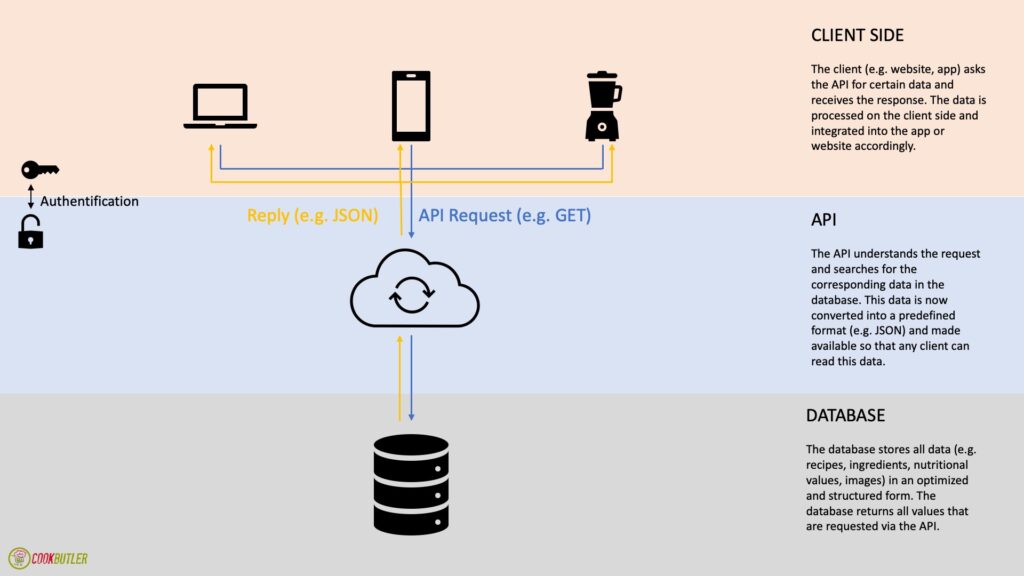
Authentication
Of course, there is a security mechanism between systems that must be followed. The client is authenticated via “access tokens” before sending a request.
API request
The process starts when the client calls the API. In doing so, the client uses a specific syntax and uses specific commands (e.g. “GET” for the recipe search). In the case of a recipe API, you can use the keyword “pasta” in your search query.
Depending on the recipe database provider, there are other filter options as well. At cookbutler.com, for example, you can also include diets like “vegetarian”, cuisines like “italian” or exclude certain allergies like “lactose free” and other criteria like “high protein” to your search query. Of course, you can also combine these filters.
Server response or reply
After receiving an authorized request, the server responds with the result. In our case, all recipes would be returned that contain pasta, are vegetarian, lactose free and rich in protein. In the response, all the necessary data is included such as the link to the image, title, description, ingredients list, category, recipe instruction and many other values such as nutrition data. The response is structured and readable by both human and computers, for example in JSON format:

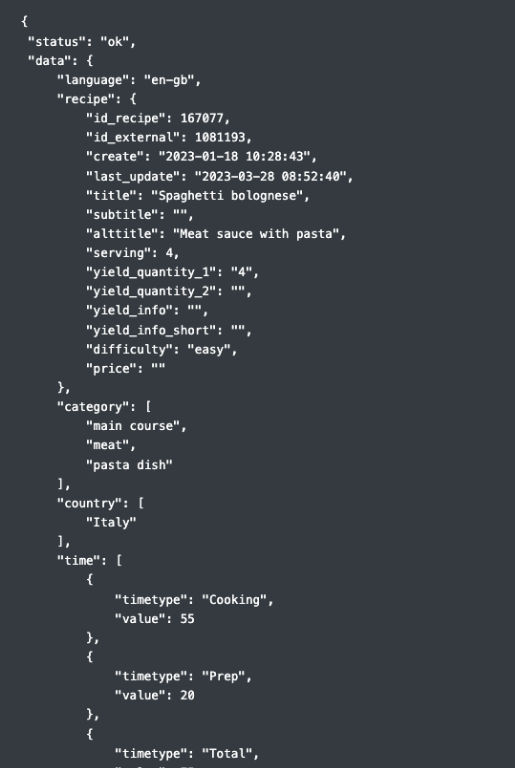
How to process and display this data is then up to the receiving “client”.
Use cases for recipe APIs
Recipe APIs can be used in many ways to deliver content that interests users. Here are just a few examples:
- Cooking apps: Cooking apps can use recipe APIs to provide a wide range of recipes to their users. Users can search by different criteria such as ingredients, nutritional info or cooking time and find recipes that fit their preferences.
- Nutritional advice and fitness apps: Applications that focus rather on health in general than cooking have different requirements. Here, recipes must include important data so that a recipe search can be adapted to the individual requirements of the user and be processed into customized meal plans.
- Shopping websites: Shopping apps can use recipe APIs to provide their users with product suggestions. For example, if a user is looking for a recipe for an Indian curry, the system can make suggestions for spices or other ingredients they need. Or the other way around: an ingredient is searched for in the online supermarket and the system immediately suggests an entire recipe to upsell additional products.
- Lifestyle blogs: Lifestyle blogs can use recipe APIs to present their readers with recipes that fit their theme. For example, if a blog writes about vegan nutrition, it can use a recipe API to offer vegan recipes to its readers.
- Kitchen appliance manufacturers: The smart kitchen already combines hardware like fridges or ovens with apps and connects them with other devices. For example, the fridge can already start to heat the oven when the ingredient is taken out for preparation. The connecting element to this is the recipe!
Overall, recipe APIs can be used in various use cases to provide users with content tailored to their needs. They can help users spend more time and improve their interaction with your website or a device.
Choosing the right provider
But beware, before you choose a recipe API, you should carefully consider which provider suits you and what features you need. Here are a few very important criteria you should consider when analyzing providers:
- License: Read the license terms of the API provider carefully what you are allowed to do and what rights you get to use the recipes including the images. If, for example, recognizable people or brands can be seen on the images, these rights must also be released by the person (model release) or the brand owners (property release). The authors of the photos and the recipes must also have given their consent.
- Linking to web recipe sources: Many recipe API providers do not have the right to licence recipes, but only mediate between users and recipe owners. The full recipe instructions may only be available on the original recipes sources. So you are sending your users away from your website or app to a third party site. Often, a credit to the author must also be provided.
- Number and quality of recipes: check the quality of the photos, ingredient lists, and instructions. Nothing is more annoying than a poorly done photo or a recipe that doesn’t work.
- Data basis: Is all the data you need supplied and is it correct? Is this data also queryable via the API? Is every filter supported?
- Functions: Check whether they can map important functions such as shopping list creation, ingredient analysis, nutrition analysis, shopping cart transfer, meal planning, etc. via the API.
Our recommendation
First, plan the ideal structure of your app or website. Write down the criteria to the API and then look for the provider that suits you.
If a function is missing, you can still discuss it with the provider.
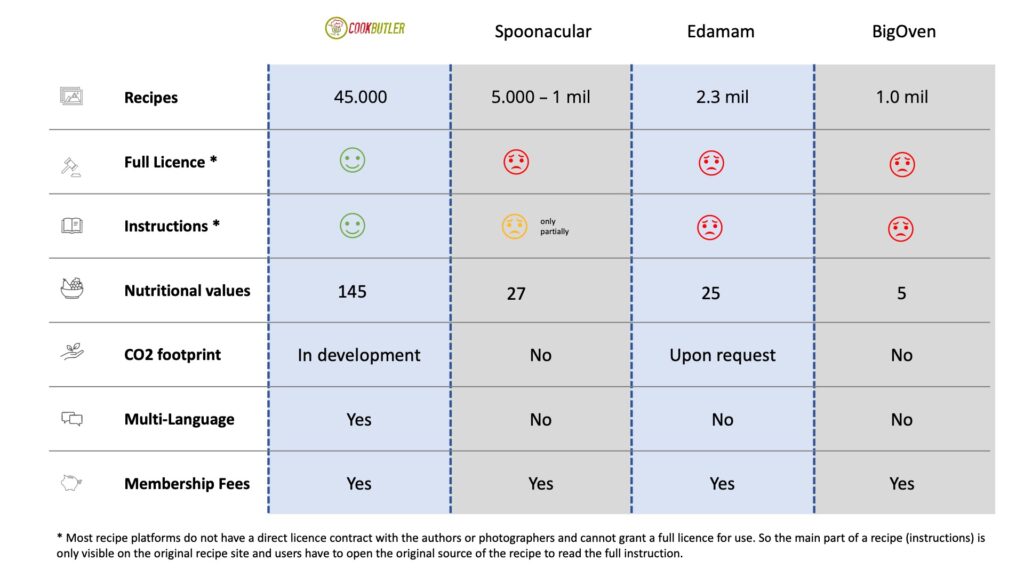
Which providers are there?
We have compiled a small overview of the leading recipe API providers.
More questions?
That’s it. I hope this has given you a good insight into what a recipe API is.
Read more about cookbutler’s “Recipe as a service” model or contact me directly.
You can view the technical documentation here.